
Exam-style practice for the NSW Opportunity Class Placement Test, with instant results, worked explanations and progress tracking.
Free Test · No sign-up · Instant score
Already decided? See plans & pricing →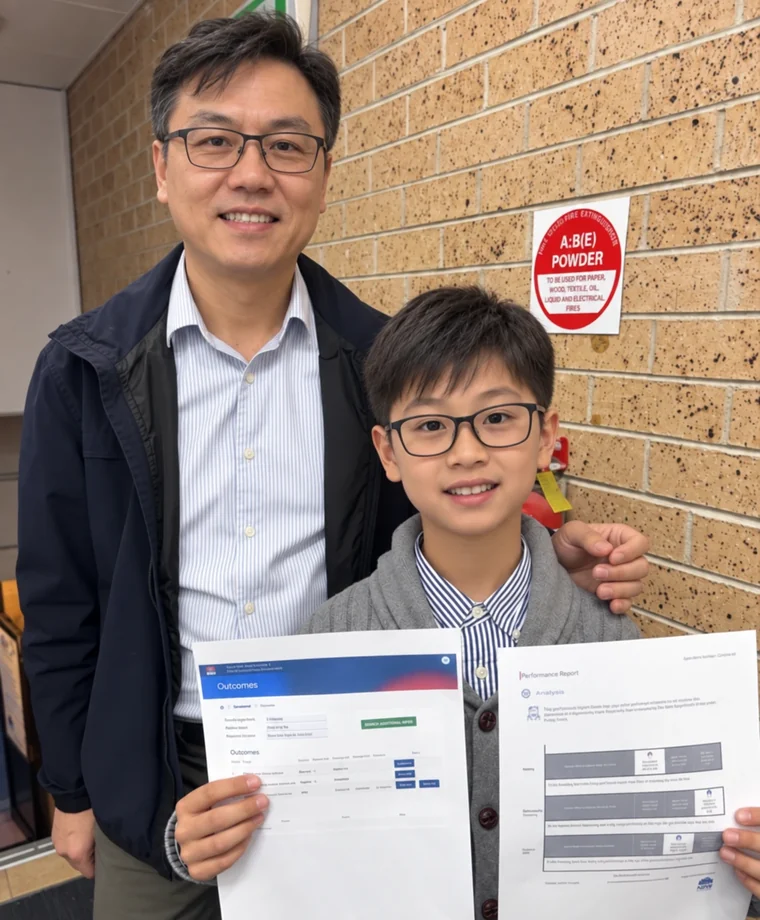
Your child sits one exam-style paper. You get a full report by email, free, with no card and no sign-up. It shows:

A sample report. Yours fills in with your child's own result.
The Opportunity Class Placement Test decides entry to NSW opportunity classes — academically selective Year 5–6 classes in selected public primary schools, for high-potential and gifted students. Children sit it in Year 4, and successful applicants start in an opportunity class in Year 5 the following year. Places are offered on academic merit, decided by the test.
From 2025 the test is sat on a computer at an allocated test centre rather than on paper at your child's own school. It has three multiple-choice sections: Reading, Mathematical Reasoning and Thinking Skills. Unlike the Selective High School test, there is no writing task.
The OC test measures thinking and reasoning, not memorised content. What genuinely helps is familiarity and confidence: knowing the on-screen format, pacing each section, and reading widely over time.
Sit the Free Test now: 10 to 13 minutes a subject, no sign-up. The score shows at once and the full report comes by email. Then choose a plan for the full practice papers.
Try a Free Test View plans & pricingThree multiple-choice sections, sat one after another on screen. There is no writing task in the OC test.
Comprehension across fiction, non-fiction and poetry. Some questions have several parts, so 14 questions ask for 33 answers. Tests how carefully your child reads and interprets.
Problem-solving and reasoning from primary maths, with five answer choices a question and no calculator. It rewards working things out, not recalling formulas.
Critical thinking and problem solving with no prior knowledge needed, four answer choices a question. Often the section that separates top scorers.
The total working time is 110 minutes, plus breaks. The Department can vary the exact number of questions and timing from year to year — confirm the current specification on the official site before your child's test.
Give your child access to the full OC Test practice package, with 60 practice papers, detailed reports and worked explanations.
The cycle runs to the same rhythm every year:
Current cycle (Year 5 entry in 2028): applications open in November 2026 and close in February 2027, the test is held in May 2027, and outcomes are released in September 2027. The calendar moved in recent years: the test is now in May (it used to be July or August), so children are still in Year 3 when applications open. Exact dates change every year — always confirm the current cycle on the NSW Department of Education website. Applications are made online by a parent or carer.
The test is sat on a Department-provided computer at an allocated test centre in NSW. Your child is given paper for working out; calculators and rulers are not allowed. The three sections run one after another, with a 10-minute break after Reading and another after Mathematical Reasoning.
If something goes wrong: if illness, injury or an unexpected event affects the test, families can lodge an illness/misadventure request within five business days, and approved students sit the make-up test. Disability adjustments can be requested when applying for children who already receive them at school.
Children sit it in Year 4, and successful applicants start in an opportunity class in Year 5 the following year.
It is computer-based, sat at an allocated NSW test centre. All three sections are answered on screen.
No. The OC test has three multiple-choice sections: Reading, Mathematical Reasoning and Thinking Skills.
There is no fixed cut-off. Results are rank-based, and the level needed is different at each school: it depends on how many students apply, how they perform and how many places there are. The Department does not publish minimum entry scores.
No special tutoring is required — the test measures thinking and reasoning, not memorised content. Familiarity with the format, timed practice and wide reading are what help most.
Yes — you can list up to four opportunity classes in order of preference. An initial offer comes from the highest-preference school your child qualifies for.
If your child isn't offered a place at first, they may go on a school's reserve list and receive a later offer as places come free — for opportunity classes, up to the end of Term 1 in Year 6. Bands A to D show roughly when an offer is likely; band E means one is unlikely.
You can lodge an illness/misadventure request within five business days of the test, and approved students sit the make-up test about two weeks later. Sitting the scheduled test wherever possible is still strongly advised.
The test is held in May (Term 2) and outcomes are released in September (Term 3). Exact dates change each year — confirm them on the NSW Department of Education site.
Last reviewed September 2026. Test facts on this page are drawn from the NSW Department of Education (placement test, outcomes and application pages). Dates and details change each year — always confirm the current cycle on the Department website. Test Magic is not affiliated with or endorsed by the NSW Department of Education.
Free articles for parents on preparing for the Opportunity Class test — study strategies, what to expect, and building your child's confidence.
Read OC test articles →