
How Movement Shapes Your Child's Mind: The Science of Learning Through the Body

You have done everything right. Your child sits down, stays still and works hard - and yet they still freeze in the test, or run out of focus halfway through. It is deeply frustrating, and it is easy to worry that something is wrong. According to cognitive scientist Sian Beilock, the missing piece is often the one we overlook most: the body.
In her book How the Body Knows Its Mind, Beilock pulls together decades of research into a single, surprising message: the way we move, gesture and use our physical surroundings shapes how we think, feel and learn. This is the science of embodied cognition - and it has real, practical implications for how your child should prepare for a big test.
What "embodied cognition" means - and why it matters for exams
For a long time, scientists treated the brain like a computer locked inside the skull: information went in, thinking happened, answers came out, and the body was just there to carry the brain around. Embodied cognition overturns that picture. As Beilock explains, the mind is not separate from the body - it is built on it. Movement, posture, gesture and even the room a child sits in all feed into how well they think.
That matters for exam preparation because we so often get the conditions wrong. We ask children to sit dead still for hours, strip movement out of "serious" study, and treat nerves as something happening only in their heads. The research says the body is doing far more of the work than we give it credit for - and that we can use it to our advantage.
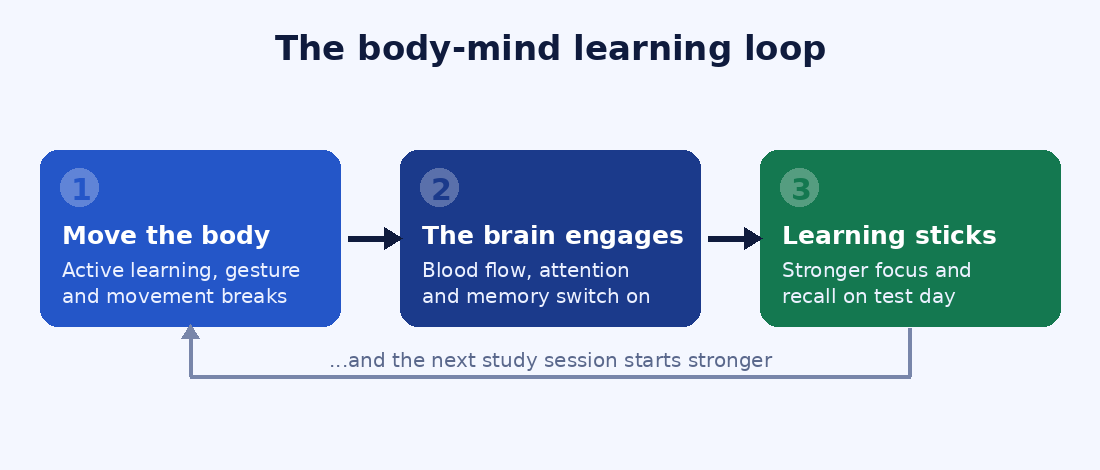
Four ways the body helps your child learn
Across Beilock's work, the same theme appears again and again: engage the body, and you sharpen the mind. Here are four that matter most for primary-aged children preparing for tests - each one we will explore in its own article in this series.
1. Movement and exercise prime the brain
Physical activity increases blood flow to the brain and switches on the networks responsible for attention and memory. A child who has moved - even a short walk or a few minutes of play - comes back to the desk genuinely ready to focus, not just told to. This is the same link we explored in how sport improves your child's school results, and Beilock's research explains why it runs so deep.
2. Gesture helps thinking - and stops "blanking"
Beilock's studies show that letting children talk with their hands actually lightens the mental load and helps ideas stick - and that gesturing while explaining an answer can stop a child freezing or losing their train of thought under pressure. When your child explains a maths problem aloud and uses their hands to do it, they are learning more deeply, not showing off.
3. Stress lives in the body - and you can calm it
Beilock is also one of the world's leading researchers on "choking under pressure" - why capable students underperform in the moments that count. Crucially, the fix is often physical and practical. In a well-known study she co-authored, published in the journal Science, students who spent about ten minutes writing down their worries immediately before an exam scored measurably higher - and the most anxious students improved the most. Calming the body and offloading the worry frees up the mental space a test demands.
4. Children learn by doing, not just by sitting
Beilock argues that motor and cognitive development go hand in hand, and that children learn best through doing rather than passively absorbing. For test preparation, that is a strong case for active, hands-on practice - working through real questions, explaining answers, and reviewing mistakes out loud - rather than re-reading notes in silence.
Putting it to work in NAPLAN, OC and Selective preparation
You do not need a sports science degree to use any of this. A few small changes make a real difference: build short movement breaks into study sessions, let your child explain answers aloud and with their hands, take the pressure off by naming and writing down nerves before a practice test, and lean on active practice over passive reading.
That last point is where a tool like Test Magic fits naturally. Practising on realistic, exam-style papers - the kind in our Selective, OC and NAPLAN practice sets - turns study into doing rather than just reading. Each paper gives an instant skills report and worked solutions, so your child can review mistakes actively and build the calm, body-and-mind readiness that holds up on test day.
The takeaway
Beilock's core message is freeing for parents: your child's body is not the enemy of focus - it is one of their best learning tools. Movement, gesture and a calm nervous system are not distractions from serious study; they are part of what makes study work. Pair that with smart practice habits - like those in our guide on how to help your child study smarter, not harder - and a calmer approach to nerves, such as helping your child stop overthinking, and you have a preparation routine that fits how children are actually built to learn.
Over the coming weeks, we will dig into each of these four ideas in detail - starting with why bright children freeze in exams, and exactly what to do about it.
In this series
Put it into practice
Start with the Free Test, then choose a plan for the full practice papers. Cancel anytime.
Start Free Test