
Comprehensive Breakdown of the 4 NSW Selective Test Components (2026)
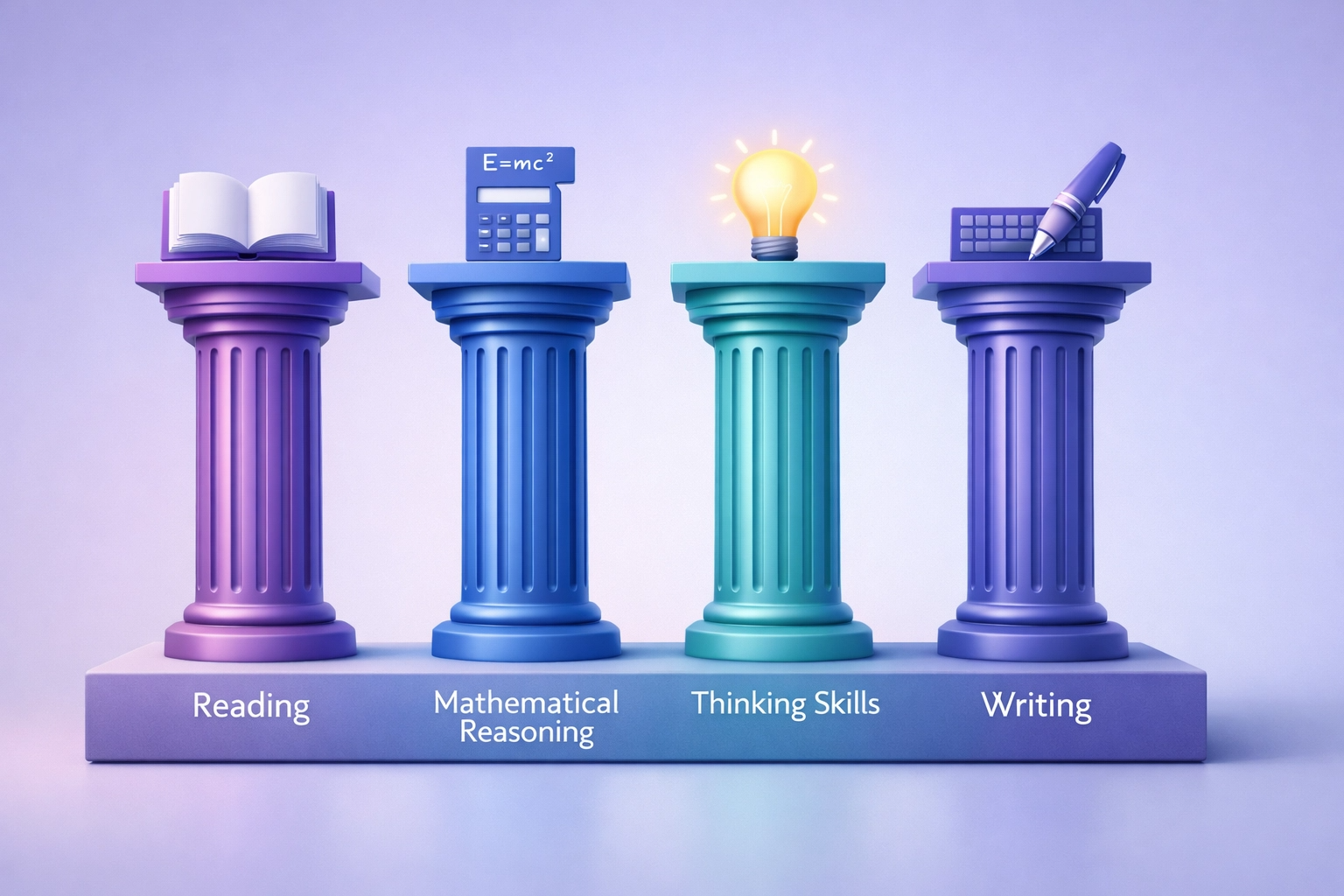
Reading, Mathematical Reasoning, Thinking Skills and Writing - four very different sections, each now carrying equal weight in 2026 - and it is hard to know where your child's time is best spent, or whether you are preparing for the right things. That uncertainty is draining. This guide is designed to replace it with clarity, breaking down exactly what each of the four NSW Selective Test components assesses and the targeted strategies that help your child do their best across all of them.
Mastering Each Section: Reading, Maths, Thinking Skills & Writing for Selective School Entry
“Success in the NSW Selective Test hinges on a deep understanding of each component. At TestMagic, we break down what each section tests and provide targeted strategies to help your child excel across the board.” — TestMagic.com.au
Last Updated: March 2026
The NSW Selective High School Placement Test is a rigorous examination designed to identify academically gifted students. It comprises four distinct components, each carrying equal weight (25%) as of 2026. Understanding the structure, content, and success strategies for each component is crucial for effective preparation.
Component 1: Reading
Purpose: To assess comprehension, inference, and critical analysis of various text types.
Aspect | Details |
Questions | Approximately 30 questions (some multi-part) |
Time | 40 minutes |
Weight | 25% of total score |
Format | Computer-based, multiple-choice |
What It Tests | Comprehension of fiction, non-fiction, and poetry; inference and deduction skills; understanding author’s purpose and tone; vocabulary in context; analysis of text structure. |
- Diverse Reading: Encourage daily reading of a wide range of text types (news articles, short stories, scientific texts, poetry).
- Inference Practice: Focus on questions that require reading between the lines and drawing conclusions from the text.
- Vocabulary Building: Develop a strong vocabulary through reading and targeted exercises.
- Time Management: Practice reading passages efficiently and allocating approximately 1.3 minutes per question.
Component 2: Mathematical Reasoning
Aspect | Details |
Questions | Approximately 35 multiple-choice questions |
Time | 40 minutes |
Weight | 25% of total score |
Format | Computer-based, no calculator permitted |
What It Tests | Number operations and patterns; algebra and equations; geometry and measurement; data interpretation; problem-solving under time pressure. |
- Mental Arithmetic: Master quick calculations without a calculator.
- Word Problems: Practice interpreting and solving complex word problems extensively.
- Pattern Recognition: Learn to identify common mathematical problem types and apply appropriate strategies.
- Accuracy First: Prioritize accuracy in calculations before focusing on speed.
Component 3: Thinking Skills
Aspect | Details |
Questions | Approximately 40 multiple-choice questions |
Time | 40 minutes |
Weight | 25% of total score |
Format | Computer-based, logical reasoning |
What It Tests | Logical deduction and reasoning; pattern recognition; spatial reasoning; argument analysis; abstract thinking. |
Component 4: Writing
Aspect | Details |
Task | 1 extended response (e.g., narrative, persuasive, informative) |
Time | 30 minutes |
Weight | 25% of total score |
Format | Computer-based typing |
Suggested Length | 200-300 words |
What It Tests | Idea development and creativity; text structure and organization; grammar and punctuation; vocabulary and expression; typing proficiency (30-35 words per minute recommended). |
- Typing Proficiency: Regular practice to build speed and accuracy on a keyboard is essential for the computer-based format.
- Text Type Mastery: Learn and practice various writing styles (narrative, persuasive, informative) and their structures.
- Vocabulary & Grammar: Develop a rich vocabulary and strong grammatical skills.
- Planning & Execution: Practice planning your response in 3-5 minutes and then writing within the remaining time limit.
Go back to the main guide: NSW Selective School Entry: Your Ultimate Guide to Placement, Scoring $ Strategy
Knowing what each paper asks is the start; sitting one to time is the rest. Our Selective practice papers are modelled on the four components above. Parents often read this alongside how the scores are put together and a twelve-week preparation schedule.
References
Put it into practice
Start with the Free Test, then choose a plan for the full practice papers. Cancel anytime.
Start Free Test